
*By Patricia Janeth Rengel Calvopiña and David Alejandro Cañas Sigüenza
In cities, we are exposed daily to air pollution generated by vehicles, factories, and much more. When we think of the Amazon rainforest, we imagine a different reality—the air is pure, everything is green, and people enjoy excellent health. Unfortunately, this image clashes radically with the reality of the Ecuadorian Amazon, particularly in areas influenced by the oil industry. There, the burning and venting of fossil gas associated with oil production negatively impact the health and quality of life of its inhabitants.
An emblematic example is the case of Niñas vs. Government of Ecuador for authorization of the burning and venting of gas in flares of oil fields in the Amazon in Ecuador. In it, the Multicompetent Chamber of the Provincial Court of Justice of Sucumbíos, accepting an appeal, declared that " the Ecuadorian State has ignored the right of the plaintiffs to live in a healthy and ecologically balanced environment; disregarding, with the polluting activity, their right to health by not promoting the use of environmentally clean technologies and non-polluting and low-impact energies ."
What is fossil gas associated with hydrocarbon production?
Oil deposits in the Amazon contain a mixture of oil, gas, and water trapped underground at high pressures. Both oil and gas are of fossil origin and are products of the decomposition of organic matter without oxygen under specific conditions: depths of 760 to 4,880 meters and temperatures between 65°C and 150°C. Below the surface, variations in these two variables—pressure and temperature—are responsible for the generation of oil (made up of at least 150 different types of hydrocarbons!), gas, and mixtures thereof.
Thus, fossil gas is the result of the degradation of organic matter under intense temperature and pressure conditions. While some of the materials become oil, others are transformed into gas. Fossil gas is a mixture of various compounds such as propane, ethane, and sulfur, but it is primarily composed of methane (CH4). Methane is considered a short-lived climate pollutant because it decomposes after 7 to 12 years in the atmosphere. However, in that relatively short time, it has a potent greenhouse effect, as its warming potential is up to 80 times greater than that of a molecule of CO2. Therefore, limiting these types of emissions today will have real and lasting effects over the next decade. Mitigating methane emissions is urgent and represents a window of opportunity to limit the planet's temperature increase.
Flaring and venting: bad practices in the hydrocarbon sector
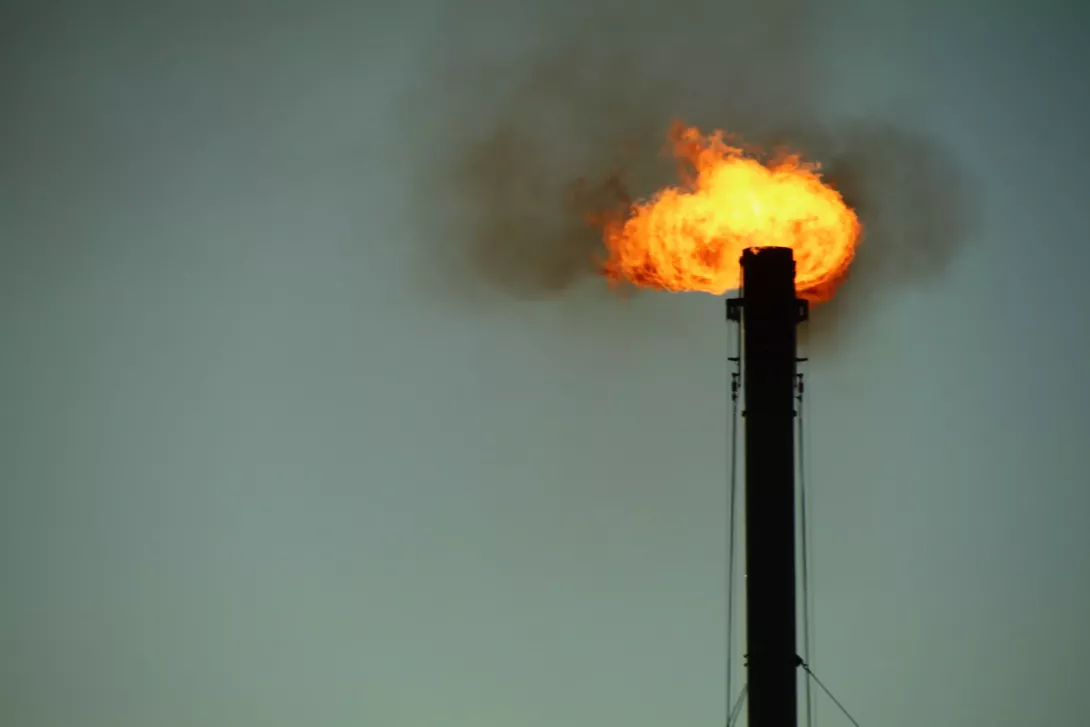
Burning and venting fossil gas is the “easy” way The oil industry has found a way to get rid of gas. What's easy is far from right. When oil is extracted, gas is also extracted from the reservoir. If the gas cannot be used or sold on the surface, it is released into the atmosphere. This is a polluting practice that exacerbates the climate crisis and has been used for years by oil producers to dispose of gas. Most commonly, the gas is burned in metal flares, which is still a bad practice because combustion also releases air pollutants that cause serious harm to human health.
The burning of gas radiates heat, producing carbon dioxide (CO2) and water. Other gases are also released, such as hydrogen sulfide (H2S), an acidic gas that becomes destructive when it mixes with water. If this gas and other byproducts of combustion in flares mix with the air, clouds and rain capture the toxic components in suspension, and the pollutant load transforms the rain into acid rain. The rains that blanket the entire territory, laden with pollutants, reach the soil and water sources, affecting every living being. Something similar happens with nitrogen oxides (NOx), which react with oxygen (O2) in the air to produce tropospheric ozone, which has very negative effects on the respiratory system and can cause inflammation of the airways, lung cancer, and other health problems.
Flaring involves releasing gas into the atmosphere, emitting methane and other gases through the flares. Although invisible without specialized equipment, the result is a plume of methane gas. Methane is colorless, which means that nearby communities and residents cannot be certain whether or not the flares are causing pollution. Furthermore, the released methane warms the atmosphere and is a precursor to tropospheric ozone, a pollutant that damages health and crops, as well as being a potent greenhouse gas.
Flaring and venting contribute to global warming and cause serious health problems over time. These harmful practices are becoming commonplace because they are inexpensive and environmental controls are scarce. They continuously release pollutants into the air, affecting not only the livelihoods and health of people in nearby communities, but also ecosystems, water, fauna, and flora around the flares, particularly during periods of prolonged exposure.
In both practices, the gas associated with oil production is seen as a product without economic value, and its energy potential, as well as its polluting and aggravating effects on the climate crisis, are not considered.
Ideally, gas should be captured and used as fuel, but oil companies avoid investing in gas capture, storage, transportation, and distribution systems. They not only disregard gas as an energy source, but also the value of pollution-free territories, the right of people in affected areas to live in a healthy environment, and the right of every inhabitant of the world to a stable climate.
Waste of resources and pollution
According to the World Bank , in 2024, at least 151 trillion cubic meters of gas were flared or vented into the atmosphere by the oil and gas sector—a record figure. To put this into perspective, it's almost half of Europe's gas consumption and exceeds the total consumption in 2023 of the world's top eight gas-consuming countries, including Saudi Arabia, Canada, Japan, and Mexico. These numbers demonstrate that the gas that is flared or vented could meet the energy needs of entire countries!
The World Bank estimates that methane emissions in 2024 could pollute as much as 389 million tons of CO2 if the combustion efficiency of fossil gas is 98% and only 2% of the methane escapes into the atmosphere without combustion. This calculation is based on the best possible combustion conditions. However, it also acknowledges that a combustion efficiency just 4 percentage points lower, at 94%, would mean three times more methane released, or 138 million tons of methane entering the atmosphere, in addition to the millions of tons of CO2 resulting from combustion.
Incomplete combustion and fugitive emissions
Gas flaring and venting are a significant source of greenhouse gas emissions that continue to exacerbate the climate crisis. The efficiency of fossil gas flaring is extremely variable, ranging from 62% to 99%, meaning that lower efficiency leads to higher methane emissions.
According to the IPCC, flaring and venting are classified as fugitive emissions. These refer to gas leaks throughout the entire gas exploration, production, refining, storage, transportation, distribution, and processing chain.
Emergency situations are perhaps the only instance in which flaring and venting can be considered acceptable practices. This occurs when system pressures rise and their reduction is necessary to avoid endangering the lives of workers and residents in the surrounding area. If there is a fire, a valve rupture, damage to the hydrocarbon extraction and production chain, or any other type of failure that compromises system stability, then, and only for short periods of time, flaring or venting gas can be considered necessary.
Why should burning in lighters be avoided?
The burning and venting of gas not only release large quantities of greenhouse gases (GHGs), but also GHG precursors, other hydrocarbons, particulate matter, and black carbon (soot). In particular, black carbon has the ability to absorb solar radiation, exacerbating the warming of the areas where it accumulates.
Unfortunately, the pollution caused by burning and venting in flares has been underestimated by industry, and there are few studies to compare it with the actual situation. Most commonly, the information available on this practice consists of general reports without details about the gas composition or the combustion process.
What can be done? Best practices and other actions
The best and most ambitious alternative is to implement processes that do not release methane into the atmosphere. In the short and medium term, to address venting or flaring, the alternative is to utilize fossil gas. This implies investments to cover the technical and infrastructure requirements necessary to condition, compress, transport, and store fossil gas. In more detail, the alternatives to the harmful practices of flaring and venting are:
- Reinjection of gas into reservoirs to be preserved for future use.
- Reinjection of gas into reservoirs for enhanced oil recovery.
- In situ or ex situ use for electricity generation.
- Installation of the storage, transport and distribution chain up to the final consumers.
The management and use of fossil gas must not only consider the economic viability of an alternative, but also the proper management of an air pollutant and a substance hazardous to health. This is the obligation and responsibility of the producers.
Final reflections
Reducing and eliminating methane emissions from the oil and gas sector presents a clear opportunity to achieve greenhouse gas reduction targets and perhaps keep climate change below 2°C, as with each passing day meeting the 1.5°C target no longer seems realistic.
Limiting burning and venting to emergency situations allows for the reduction of greenhouse gases, including methane, and opens a giant window of opportunity in our race to keep the planet's temperature at levels that allow for the stable development of life.
Reducing the venting and flaring of fossil gas is a necessary measure both to mitigate climate change and to ensure that historically affected communities receive compensation and have their right to a healthy environment restored. Alternatives exist, along with technical and economic feasibility analyses, for the capture, transport, and end use of gas. Guidelines for implementing these alternatives must evolve to consider not only economic costs, investments, and royalties, but also the environmental and climate costs of not implementing them.
Until now, burning and venting have been common, but these are practices that must be eliminated to guarantee the right to a healthy environment.
*By Patricia Janeth Rengel Calvopiña and David Alejandro Cañas Sigüenza
In cities, we are exposed daily to air pollution generated by vehicles, factories, and much more. When we think of the Amazon rainforest, we imagine a different reality—the air is pure, everything is green, and people enjoy excellent health. Unfortunately, this image clashes radically with the reality of the Ecuadorian Amazon, particularly in areas influenced by the oil industry. There, the burning and venting of fossil gas associated with oil production negatively impact the health and quality of life of its inhabitants.
An emblematic example is the case of Niñas vs. Government of Ecuador for authorization of the burning and venting of gas in flares of oil fields in the Amazon in Ecuador. In it, the Multicompetent Chamber of the Provincial Court of Justice of Sucumbíos, accepting an appeal, declared that " the Ecuadorian State has ignored the right of the plaintiffs to live in a healthy and ecologically balanced environment; disregarding, with the polluting activity, their right to health by not promoting the use of environmentally clean technologies and non-polluting and low-impact energies ."
What is fossil gas associated with hydrocarbon production?
Oil deposits in the Amazon contain a mixture of oil, gas, and water trapped underground at high pressures. Both oil and gas are of fossil origin and are products of the decomposition of organic matter without oxygen under specific conditions: depths of 760 to 4,880 meters and temperatures between 65°C and 150°C. Below the surface, variations in these two variables—pressure and temperature—are responsible for the generation of oil (made up of at least 150 different types of hydrocarbons!), gas, and mixtures thereof.
Thus, fossil gas is the result of the degradation of organic matter under intense temperature and pressure conditions. While some of the materials become oil, others are transformed into gas. Fossil gas is a mixture of various compounds such as propane, ethane, and sulfur, but it is primarily composed of methane (CH4). Methane is considered a short-lived climate pollutant because it decomposes after 7 to 12 years in the atmosphere. However, in that relatively short time, it has a potent greenhouse effect, as its warming potential is up to 80 times greater than that of a molecule of CO2. Therefore, limiting these types of emissions today will have real and lasting effects over the next decade. Mitigating methane emissions is urgent and represents a window of opportunity to limit the planet's temperature increase.
Flaring and venting: bad practices in the hydrocarbon sector
Burning and venting fossil gas is the “easy” way The oil industry has found a way to get rid of gas. What's easy is far from right. When oil is extracted, gas is also extracted from the reservoir. If the gas cannot be used or sold on the surface, it is released into the atmosphere. This is a polluting practice that exacerbates the climate crisis and has been used for years by oil producers to dispose of gas. Most commonly, the gas is burned in metal flares, which is still a bad practice because combustion also releases air pollutants that cause serious harm to human health.
The burning of gas radiates heat, producing carbon dioxide (CO2) and water. Other gases are also released, such as hydrogen sulfide (H2S), an acidic gas that becomes destructive when it mixes with water. If this gas and other byproducts of combustion in flares mix with the air, clouds and rain capture the toxic components in suspension, and the pollutant load transforms the rain into acid rain. The rains that blanket the entire territory, laden with pollutants, reach the soil and water sources, affecting every living being. Something similar happens with nitrogen oxides (NOx), which react with oxygen (O2) in the air to produce tropospheric ozone, which has very negative effects on the respiratory system and can cause inflammation of the airways, lung cancer, and other health problems.
Flaring involves releasing gas into the atmosphere, emitting methane and other gases through the flares. Although invisible without specialized equipment, the result is a plume of methane gas. Methane is colorless, which means that nearby communities and residents cannot be certain whether or not the flares are causing pollution. Furthermore, the released methane warms the atmosphere and is a precursor to tropospheric ozone, a pollutant that damages health and crops, as well as being a potent greenhouse gas.
Flaring and venting contribute to global warming and cause serious health problems over time. These harmful practices are becoming commonplace because they are inexpensive and environmental controls are scarce. They continuously release pollutants into the air, affecting not only the livelihoods and health of people in nearby communities, but also ecosystems, water, fauna, and flora around the flares, particularly during periods of prolonged exposure.
In both practices, the gas associated with oil production is seen as a product without economic value, and its energy potential, as well as its polluting and aggravating effects on the climate crisis, are not considered.
Ideally, gas should be captured and used as fuel, but oil companies avoid investing in gas capture, storage, transportation, and distribution systems. They not only disregard gas as an energy source, but also the value of pollution-free territories, the right of people in affected areas to live in a healthy environment, and the right of every inhabitant of the world to a stable climate.
Waste of resources and pollution
According to the World Bank , in 2024, at least 151 trillion cubic meters of gas were flared or vented into the atmosphere by the oil and gas sector—a record figure. To put this into perspective, it's almost half of Europe's gas consumption and exceeds the total consumption in 2023 of the world's top eight gas-consuming countries, including Saudi Arabia, Canada, Japan, and Mexico. These numbers demonstrate that the gas that is flared or vented could meet the energy needs of entire countries!
The World Bank estimates that methane emissions in 2024 could pollute as much as 389 million tons of CO2 if the combustion efficiency of fossil gas is 98% and only 2% of the methane escapes into the atmosphere without combustion. This calculation is based on the best possible combustion conditions. However, it also acknowledges that a combustion efficiency just 4 percentage points lower, at 94%, would mean three times more methane released, or 138 million tons of methane entering the atmosphere, in addition to the millions of tons of CO2 resulting from combustion.
Incomplete combustion and fugitive emissions
Gas flaring and venting are a significant source of greenhouse gas emissions that continue to exacerbate the climate crisis. The efficiency of fossil gas flaring is extremely variable, ranging from 62% to 99%, meaning that lower efficiency leads to higher methane emissions.
According to the IPCC, flaring and venting are classified as fugitive emissions. These refer to gas leaks throughout the entire gas exploration, production, refining, storage, transportation, distribution, and processing chain.
Emergency situations are perhaps the only instance in which flaring and venting can be considered acceptable practices. This occurs when system pressures rise and their reduction is necessary to avoid endangering the lives of workers and residents in the surrounding area. If there is a fire, a valve rupture, damage to the hydrocarbon extraction and production chain, or any other type of failure that compromises system stability, then, and only for short periods of time, flaring or venting gas can be considered necessary.
Why should burning in lighters be avoided?
The burning and venting of gas not only release large quantities of greenhouse gases (GHGs), but also GHG precursors, other hydrocarbons, particulate matter, and black carbon (soot). In particular, black carbon has the ability to absorb solar radiation, exacerbating the warming of the areas where it accumulates.
Unfortunately, the pollution caused by burning and venting in flares has been underestimated by industry, and there are few studies to compare it with the actual situation. Most commonly, the information available on this practice consists of general reports without details about the gas composition or the combustion process.
What can be done? Best practices and other actions
The best and most ambitious alternative is to implement processes that do not release methane into the atmosphere. In the short and medium term, to address venting or flaring, the alternative is to utilize fossil gas. This implies investments to cover the technical and infrastructure requirements necessary to condition, compress, transport, and store fossil gas. In more detail, the alternatives to the harmful practices of flaring and venting are:
- Reinjection of gas into reservoirs to be preserved for future use.
- Reinjection of gas into reservoirs for enhanced oil recovery.
- In situ or ex situ use for electricity generation.
- Installation of the storage, transport and distribution chain up to the final consumers.
The management and use of fossil gas must not only consider the economic viability of an alternative, but also the proper management of an air pollutant and a substance hazardous to health. This is the obligation and responsibility of the producers.
Final reflections
Reducing and eliminating methane emissions from the oil and gas sector presents a clear opportunity to achieve greenhouse gas reduction targets and perhaps keep climate change below 2°C, as with each passing day meeting the 1.5°C target no longer seems realistic.
Limiting burning and venting to emergency situations allows for the reduction of greenhouse gases, including methane, and opens a giant window of opportunity in our race to keep the planet's temperature at levels that allow for the stable development of life.
Reducing the venting and flaring of fossil gas is a necessary measure both to mitigate climate change and to ensure that historically affected communities receive compensation and have their right to a healthy environment restored. Alternatives exist, along with technical and economic feasibility analyses, for the capture, transport, and end use of gas. Guidelines for implementing these alternatives must evolve to consider not only economic costs, investments, and royalties, but also the environmental and climate costs of not implementing them.
Until now, burning and venting have been common, but these are practices that must be eliminated to guarantee the right to a healthy environment.