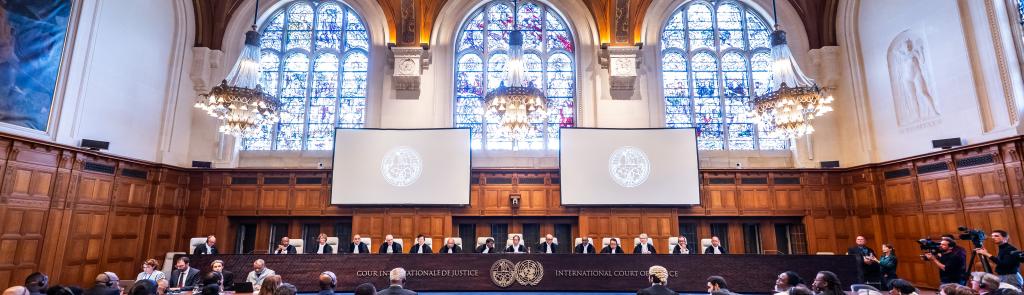
On a planet beset by crises of all kinds, two recent decisions by international courts mark milestones of hope. On July 3 and 23, respectively, the Inter-American Court of Human Rights (IACHR) and the International Court of Justice (ICJ) issued advisory opinions reaffirming the obligations of states to protect the climate system, the environment, and human rights from the impacts of the climate crisis.
These two instruments are the result of the tireless work of communities, indigenous peoples, social organizations and some progressive States in favor of justice, the good of the planet and all of humanity.
What are OCs and why do they matter?
Advisory opinions are legal pronouncements issued by international tribunals at the request of States or authorized bodies. They are binding insofar as they interpret rules of international law that impose obligations on States.
This means that what the courts say in these opinions are not mere recommendations; they constitute enforceable international law. However, their implementation, as is often the case with international law, depends on the political will of states and domestic courts, since there are no international mechanisms to compel compliance.
Therefore, their transformative potential will depend largely on our ability as civil society to activate them, disseminate them, strengthen them, and give them teeth so that they can result in the transformative changes we so desperately need.
Some key points of each decision
The Inter-American Court of Human Rights' Advisory Opinion 32/25: Climate Justice from the South
Requested by the States of Colombia and Chile, this Advisory Council focuses on the obligation of States to protect human rights in the face of the climate crisis. It is strongly grounded in the realities and knowledge of the Global South, making it especially relevant for our region. Some of its most valuable contributions include:
- It recognizes the climate crisis as a real, serious and urgent threat to human rights.
- It establishes that States have legal obligations, not just voluntary commitments, to address it from a human rights perspective.
- It states that the right to a healthy climate is part of the right to a healthy environment, which must be protected for present and future generations.
- It recognizes nature as a subject of rights and promotes the integration of local, traditional and indigenous knowledge with the best available science.
- It emphasizes the need to protect, above all, the most vulnerable groups, mentioning—among others—women, indigenous peoples, and human rights defenders.
- It establishes that States must define and maintain mitigation and adaptation goals, as well as regulate business activities.
The ICJ's Central Office: From the world's leading international court
Sponsored by the island nation of Vanuatu and supported by more than 130 countries, this Advisory Council on climate obligations interprets those obligations under international law, including treaties and customary international law. Among its key points, the decision is:
- It states that climate change represents an urgent and existential threat, making addressing it a universal responsibility.
- It recognizes that environmental protection is an indispensable condition for the effective enjoyment of human rights.
- It establishes that failure to comply with mitigation commitments constitutes an internationally wrongful act and generates legal responsibility for States. This responsibility can be invoked even by States that have not suffered direct damage, opening the door to litigation between States.
- It establishes that States can also be held responsible for failing to take the necessary measures to regulate and limit emissions from private actors under their jurisdictions.
- It considers illegal any actions that promote the production or consumption of fossil fuels, such as laws, public policies or decisions, mentioning subsidies as an example.
- It states that when an international act causes damage, the responsible state has an obligation to repair it. The lack of quantitative precision regarding that damage does not eliminate the obligation.
- It clarifies that states' obligations regarding climate change do not depend exclusively on the treaties they have signed. These obligations also stem from customary international law and erga omnes norms , that is, norms that bind all states due to their universal nature.
A call to action for civil society
These opinions are invaluable historical legal achievements, but their true power will depend on how we use them. Therefore, as organized civil society, we have a fundamental role to play in:
- Disseminate them widely, translating them into clear and accessible language to reach judges, legislators, government authorities, companies, communicators, communities and grassroots activists.
- Use them strategically in litigation and advocacy processes, integrating them into legal arguments, promoting legislative and regulatory reforms, and strengthening pressure campaigns to demand climate action.
Conclusion
The value of these instruments should not be underestimated. They are a key tool for strengthening climate litigation, environmental protection, and human rights in particularly dark times for humanity.
But we shouldn't romanticize them either. It's important to recognize their limitations, understanding that we must demand and pressure for their implementation, since ultimately their application depends on the will of the States.
The challenge is in our hands. As organizations, human rights defenders, communities, and activists, we have the opportunity to turn these words into real transformation. Let's celebrate that they exist, but let's not stop there. Let's join forces to make them count.