News

Search for climate litigation news in Latin America and the Caribbean and around the world.

Use the search filters or the keyword search to find the information you need.

Mexico: Supreme Court reaffirms that organizations can continue to defend the right to a healthy environment

News
portada de la suprema corte de mexico


In Mexico, the Supreme Court of Justice of the Nation ruled by majority vote that there is no conflict of legal precedent limiting the legitimate interest of civil society organizations in filing injunctions regarding human rights. The ruling prevents a serious setback in access to environmental and climate justice in the country, confirming that these organizations can continue to defend the right to a healthy environment.


This is a victory for strategic litigation in Mexico, including climate litigation, as the decision guarantees progressivity in judicial criteria regarding legitimate interest and favors the active participation of organizations that defend the environment.


The legitimate interest in defending diffuse and collective rights, especially in environmental matters, must be interpreted broadly because environmental damage can extend beyond the place where it occurs due to the interconnectedness of ecosystems. Thus, guaranteeing access to justice implies the standing of individuals and entities that do not even reside in the territory where the damage occurs.


Although organizations celebrated the achievement, they reiterated their demand for transparency, public dialogue, and vigilance against any attempt to restrict citizen participation in the country.


More information here .


vea más

Ruling that invokes OC-32/25 of the Inter-American Court of Human Rights declares Colombian moorland a subject of rights

Alert
Paramo santurban dia nublado colombia


In one of the first rulings to incorporate arguments from Advisory Opinion 32 (OC-32/25) of the Inter-American Court of Human Rights on human rights and the climate emergency, the Administrative Court of Santander, Colombia, declared the Santurbán páramo a subject of rights and established that the National Environmental Licensing Authority must refrain from granting, extending, or modifying permits for extractive activities (mining, hydrocarbon extraction, large dams) in the ecosystem, a vital carbon sink. This ruling sets a key precedent connecting international climate jurisprudence with national environmental protection and strengthens Latin American ecological constitutionalism by promoting an integrated vision that articulates the principle of interdependence, intergenerational justice, and the ethics of responsibility in the face of the climate crisis.


More information here


vea más

NGOs file lawsuit to stop oil exploitation off the Amazon River

News
Foz do rio amazonas no oceano atlantico


A group of eight NGOs —including Greenpeace, WWF and the country's main indigenous organization— filed a lawsuit in a Brazilian federal court to request the annulment of the permit granted to Petrobras, a state-owned company, to search for oil in a maritime area near the mouth of the Amazon River.


According to the complaint, the authorization ignores the climate impact of oil extraction in the area, which translates into increased greenhouse gas emissions or the damage from a possible oil spill in an extremely sensitive ecosystem.


On the other hand, the organizations point out that when allowing oil activity, the indigenous peoples of the region were not consulted in a "free, prior and informed" manner, which goes against the international treaties signed by the Brazilian State.


They also argue that 20% of the crude oil extracted from the well, located about 500 kilometers from the mouth of the Amazon, would sink and could affect the Amazonian coral reef system.


The Ministry of Environment assured that the project's licensing process, which lasted almost five years, was carried out with "rigor" and that Petrobras had introduced improvements to respond to hypothetical emergencies.


More information here and here .


vea más

COP 30, advisory opinions and climate litigation: 3 keys to climate justice

Blog
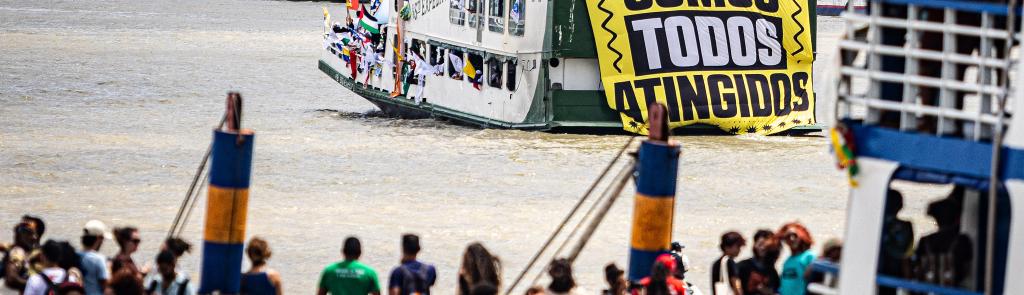
COP30 Belém Brasil - Hermes Caruzo/COP30


This year, the UN Climate Change Conference (COP30) is being held in Belém do Pará, in the heart of the Brazilian Amazon. We haven't had a COP on Latin American soil since the one held in Lima in 2014. And this one is particularly relevant because it's taking place in the heart of one of the planet's most important ecosystems, home to Indigenous peoples and communities who have protected it since time immemorial. This setting serves as a necessary reminder: without environmental and territorial justice, there will be no climate justice.


COP30 also comes at a time charged with symbolism and tension: it marks 10 years since the adoption of the Paris Agreement and there are only five years left until 2030, the deadline for countries to drastically reduce their emissions if they want to meet the goal of keeping the global temperature well below 2°C, hopefully 1.5°C.


This year, States Parties to the United Nations Framework Convention on Climate Change are due to submit their new Nationally Determined Contributions (NDCs). But so far, only 86 have been submitted (covering 113 countries, including the Member States of the European Union). These NDCs put global emissions on track to be reduced by 12% by 2035 compared to 2019 levels. Meanwhile, oil and gas use continues to expand, and references to phasing out fossil fuels, barely incorporated into recent decisions, remain timid given the scale of the crisis. In this context, the following question arises: how do we move from the legal recognition of climate obligations to real change through actions and policies?


Here, three key elements come into play: 1) advisory opinions; 2) climate litigation, fueled by these and which may generate changes in the negotiations; 3) and COP30 as a scenario.


Advisory opinions (AOs) do not invent anything new; they highlight rights that are intrinsic to people and nature.


Recently, three international tribunals issued advisory opinions on the climate crisis: the Inter-American Court of Human Rights (IACHR) with its Opinion OC-32/25, the International Court of Justice (ICJ), and the International Tribunal for the Law of the Sea . These pronouncements do not create new norms, but rather do something far more powerful: they interpret and strengthen existing obligations under international law, based on human dignity and the integrity of nature. Legally, there is no longer any doubt: States are obligated to protect nature and people from climate impacts, to regulate and control companies and other private entities responsible for emissions and damage, and to cooperate internationally with other States to combat and respond to the climate crisis.


Collaboration between States is no longer optional, and this COP must be a clear manifestation of that obligation, as well as an opportunity to rebuild trust in multilateralism.


The Achilles' heel of international law: without implementation, we remain on paper


Climate change organizations share the classic limitation of international law: there is no "global police" to enforce compliance. Their power depends on their use, and that's where climate litigation becomes an essential tool.


Strategic climate litigation, which we use to mobilize our authorities, is not an “enemy of the state.” On the contrary, it enables public authorities to uphold existing laws and regulate the private sector, which can halt projects incompatible with a stable climate, protect frontline communities, and lead to more ambitious policies and plans.


COP30 offers the perfect setting to connect these elements:

  • A climate crisis that is becoming increasingly evident.
  • Legal obligations clearer than ever.
  • A civil society willing and ready to use all available tools.


The role of the Climate Litigation Platform for Latin America and the Caribbean


Climate litigation is strengthened through use, and cases become more robust when they are shared, compared, linked, and learned from, replicating and scaling what works. This is precisely the purpose of the Climate Litigation Platform for Latin America and the Caribbean : to register cases, systematize arguments, and facilitate connections, information, and resources.


In recent years, we have seen a significant increase in cases in the region. With the publication of the Constitutional Court Orders, we are witnessing a new wave of cases, based on and motivated by these invaluable instruments of international law.


Four cases that show the renewed vigor of climate litigation


There are concrete examples that illustrate how civil society organizations are permeating climate litigation, providing tools for states to prevail over corporations:


  1. Mining in the Santurbán moorland (Colombia) and nature as a subject of rights


In July of this year, the Administrative Court of Santander declared the Santurbán moorland a subject of rights, designating the Ministry of Environment as its legal representative and prohibiting mining licenses in the area.


This   The ruling used for the first time arguments from the Inter-American Court of Human Rights' Opinion OC-32/25, reaffirming the structural interdependence between human rights and the protection of nature; consolidating the legal duty of environmental protection beyond politics.


  2. Petrobras and the search for oil at the mouth of the Amazon (Brazil)


Last October, organizations and networks of environmental, indigenous, quilombola and artisanal fishing movements sued the Brazilian Institute of Environment and Renewable Natural Resources, Petrobras and the Federal Union of Brazil requesting the annulment of the license for Block FZA-M-59, which allowed the oil company to begin oil drilling activities at the mouth of the Amazon River.


The initial petition invokes Inter-American Court of Human Rights Advisory Opinion 32/25 to demand the highest standards of due diligence, intergenerational justice, and the protection of territories and communities from fossil fuel projects in sensitive areas. The case is not limited to mitigating existing environmental damage, but also encompasses the recognition and prevention of specific risks that threaten children and their multiple rights.


If resolved favorably, the case could set precedents regarding environmental licensing, participation of indigenous communities and vulnerable populations, as well as the responsibility of state-owned companies within the framework of the energy transition.


  3. Whales and fossil gas in the Gulf of California (Mexico)


In September of this year, Nuestro Futuro AC presented a   A lawsuit was filed opposing the authorization to convert a regasification project into an export gas plant without a new and comprehensive environmental impact assessment. The authorization allowed the advancement of a fossil fuel megaproject in the Gulf of California, a vital habitat for gray, humpback, and blue whales.


The lawsuit based its claims on Inter-American Court of Human Rights Advisory Opinion 32/25 and other international instruments to recognize whales as rights holders. The case seeks to halt a fossil fuel megaproject and consolidate an ecocentric approach, protecting a key ecosystem for marine life, fishing, and the climate.


  4.- Filipino communities vs. Shell (UK)


In October, a group of 70 survivors of Super Typhoon Odette announced a lawsuit against Shell in UK courts. Their intention is to link historical emissions to the specific damage caused by the devastating storm that struck the Philippines in December 2021, citing the ICJ's advisory opinion and attribution science.


Invoking the "polluter pays" principle, the case seeks financial compensation for damages suffered, as well as a court order limiting Shell's future actions. This would be the first civil lawsuit to directly link the actions of major oil corporations to deaths and personal injuries resulting from climate impacts in the Global South.


Based on all of the above, we can conclude that climate justice does not wait, it evolves and claims its place in every possible international space.

This year, COP30 will undoubtedly have a distinctive character, marked by the progress of climate litigation around the world.
 

vea más

Communities in climate-vulnerable situations halt mining project in Bolivia

Alert
Parque nacional tuvabaca bolivia


Indigenous communities of the Tucabaca Municipal Wildlife Reserve and Natural Heritage Conservation Unit —located in the municipality of Roboré, department of Santa Cruz, Bolivia— managed to stop mining prospecting and exploration activities in their territory by the company Walfremar SRL.


In July 2024, the communities filed a class action lawsuit against the company and against the Mining Administrative Jurisdictional Authority (AJAM), an entity dependent on the Ministry of Mining that authorized the mining activities.


This action expressly highlighted the importance of considering the climate dimension in classic mining cases: “Given the climate crisis affecting the planet and whose effects are hitting the communities most vulnerable to climate change, it is necessary for the State to guarantee and respect the exercise of collective rights over the environment and common goods of indigenous peoples,” the lawsuit reads.


The communities argued that the authorization violated the rights of Indigenous peoples enshrined in the Bolivian Constitution, ILO Convention 169, and the American Convention on Human Rights. They demanded compliance with existing environmental regulations in their municipality, as well as respect for their decisions, since they had already rejected mining activity in their territory.


On August 5, 2024, the prospecting and exploration permit for the company was revoked.


More information here .


vea más

A scientific model allows us to calculate the climate damage caused by hydrocarbon companies

News
empresa petrolifera hidrocarburo


Two researchers —Justin Mankin, an associate professor at Dartmouth (New Hampshire), and Chris Callahan, a postdoctoral researcher at Stanford University (California)— claim to have created a tool that allows them to calculate the damage caused by pollution from each oil and gas company in terms of global warming, as well as the amount of money they could be forced to pay if they are successfully sued.


According to an article published by both academics, the greenhouse gas emissions of 111 fossil fuel companies caused, between 1991 and 2020, damages quantified at 28 trillion dollars worldwide.


Scientists say their model can determine a company's share of responsibility over any given time period, which could fuel climate litigation.


“For a long time, there has been a veil of plausible deniability behind which any emitter could hide: ‘We all emit greenhouse gases, so who can say that mine are responsible for outcomes X, Y, or Z?’” Mankin told The Washington Post. “Now we can do that accounting exercise.”


However, it is also possible that these types of calculations could unleash a "battle of experts" in the courts, with scientists hired by each side using different models and arriving at contradictory results regarding a company's responsibility for the climate crisis and its impacts.


More information here .

vea más

SEI and AIDA report examines the impact of climate litigation on the hydrocarbons sector

usina de petroleo informe hidrocarburos aida


The Stockholm Environment Institute (SEI) and the Inter-American Association for Environmental Defense (AIDA) launched Climate Litigation in the Hydrocarbons Sector: Perspectives from Latin America and the Caribbean , a report that analyzes the impact of climate litigation in the oil and gas sectors in Latin America and the Caribbean, assessing its contribution to climate governance and its role in preventing and repairing human rights violations.


The publication compares trends between the Global North and South to identify patterns, challenges, and opportunities in the future development of climate litigation. Based on a literature review and data from specialized databases, the study offers a comprehensive overview of the current state of climate litigation in the region, identifying legal strategies, key actors, and emerging trends.


Based on 27 cases in 7 countries, the report examines the influence of climate litigation on energy transition policies and on the prevention and redress of human and collective rights violations associated with the production, exploration and exploitation of fossil fuels.


The publication is aimed at a diverse audience, including legal professionals, members of the judiciary, policymakers, activists, civil society organizations, and academic communities from various disciplines. It is available in Spanish and will soon be available in English.


👉 Read the full report here

vea más

Young people sue the Trump administration for violating their right to life

News
cupula congreso estados unidos


A group of 22 young people from the states of Montana, Hawaii, Oregon, California, and Florida filed a lawsuit against the administration of US President Donald Trump for violating their rights to life and liberty with executive orders that promote oil and gas production, hinder carbon-free energy, and threaten to further destabilize the climate.


The lawsuit was filed in the District Court of Montana to challenge three executive orders: “Unleashing American Energy,” “Declaring a National Energy Emergency,” and “Revitalizing America’s Beautiful Clean Coal Industry.” The lawsuit argues that these orders intentionally promote an agenda by the Trump administration that will increase greenhouse gas pollution, infringing on young people’s constitutional rights to life and liberty, as well as laws protecting public health and the environment.


With the litigation, the plaintiffs seek to have the court declare the executive orders unconstitutional, block their implementation, and reaffirm the legal limits of presidential power.


The case is the latest in a series of climate lawsuits driven by young people and filed by the non-profit law firm Our Children's Trust .


More information here and here .

vea más
Showing 11 - 20 of 35 results.